


This is a simple Radius chart and TPI (Teeth Per Inch) chart for hobby and small carbon blades or
Need help choosing a wood bandsaw blade?
Use our Wood Bandsaw Blade TPI & Radius Calculator to check tooth pitch and blade width before ordering.
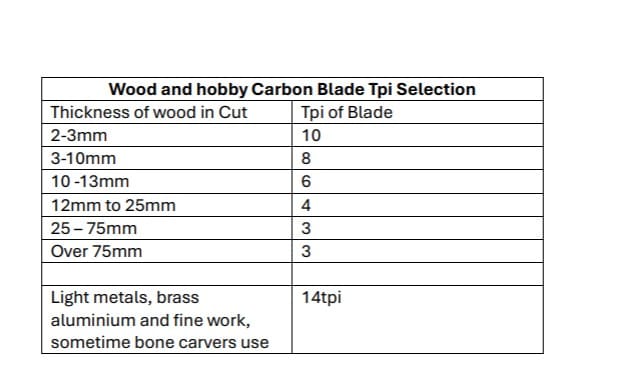
Please note: 6mm hobby doesn’t come in 3 tpi as cutting over 30mm with a 6mm hobby blade
is asking a bit too much of the saw and the very fine blade
For Portable Sawmill Bandsaw Blades TPI See this page
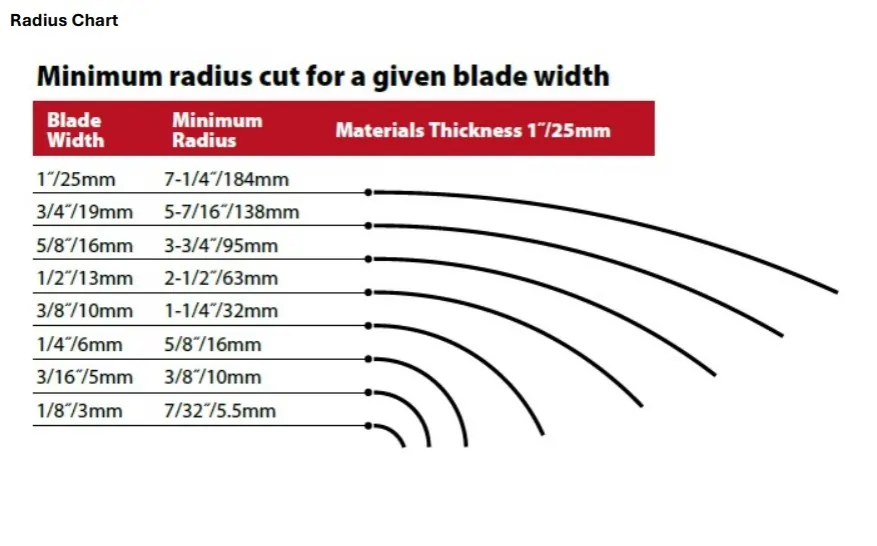
Why can’t I cut a tighter radius with a wider blade?
A bandsaw blade must change direction continuously as it follows a curved cut. The limiting factor is the relationship between the blade width and the kerf (the cut width created by the tooth set).
The kerf only provides a small amount of sideways clearance. A wide blade has a much greater distance from the cutting teeth to the back edge of the blade, so within that limited clearance it can only change direction by a small angle before the back of the blade begins to bind against the side of the cut. A narrow blade has a much shorter distance from the teeth to the back edge, allowing it to rotate through a greater angle within the same kerf and therefore follow a much tighter curve.
This is why wider blades are suited to straight cutting and large sweeping curves, while narrower blades are required for tight radius work. For straight cutting, ripping, resawing and gentle curves, the widest blade your machine can correctly tension is generally the best choice because it provides greater beam strength, tracks straighter and is less prone to wandering.
👉Use the online calculator
👉 Measure your Bandsaw Blade Length
👉 Order a Bandsaw Blade online
