


M51 vs PM51 Bandsaw Blades: What’s Changed — and Why It Matters
When workshops look to step up from standard M42 bi‑metal bandsaw blades, M51 is usually the next material mentioned.
Traditionally, M51 has been the go‑to choice for harder steels, stainless, and applications where M42 wears too quickly.
In recent years, PM51 has also started appearing — sometimes described as a new grade, sometimes as a replacement for M51. In reality, PM51 isn’t a different class of blade at all. PM51 is M51 manufactured using a newer powder‑metallurgy process, designed to improve durability and consistency under real workshop conditions.
For many New Zealand workshops, the more important question isn’t what PM51 stands for, but why modern M51‑class blades behave differently to older M51, and when that difference actually matters in day‑to‑day cutting.
This guide explains M51 and PM51 in practical terms — not as a product comparison, but as an evolution — with a focus on how these blades perform in real machines, with real operators, cutting real materials.
What Is M51 Bi‑Metal?
M51 refers to a high‑speed steel (HSS) tooth material used in bi‑metal bandsaw blades. Compared to M42, M51 contains higher levels of alloying elements such as cobalt and molybdenum, giving it higher hot hardness and improved wear resistance.
M51 has traditionally been used for:
• Stainless steels
• Tool steels
• Higher‑tensile alloys
• Applications where M42 blade life is limited
In controlled cutting environments, conventional M51 performs very well and can deliver excellent blade life.
The Limitation of Conventional M51
Traditional M51 is produced using conventional casting and rolling processes. While this achieves high hardness, it also results in a relatively coarse carbide structure within the tooth material.
In real workshop conditions, this can mean:
• Larger, less evenly distributed carbides
• Greater susceptibility to tooth edge chipping
• Reduced tolerance of interrupted cuts and thermal cycling
With stable production environments, these limitations may never appear.
Jobbing workshops with mixed materials, variable feeds, or multiple operators, they often do.
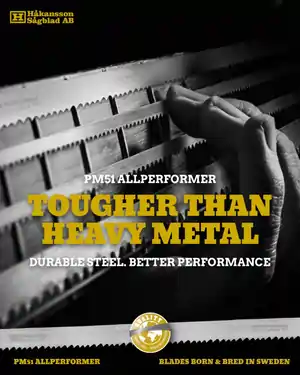
Image: PM51 Allperformer – Håkansson Sågblad AB (manufacturer overview)
What Is PM51?
PM51 stands for Powder Metallurgical M51.
Instead of being cast in molten form, PM51 tooth material is produced from extremely fine metal powders that are compacted and sintered under controlled conditions. This process produces a much finer and more uniform microstructure.
The practical result is:
• Improved resistance to tooth chipping
• Better tolerance of shock loads and interrupted cuts
• More predictable wear patterns
• Increased durability in inconsistent cutting conditions
Importantly, PM51 is still M51 high‑speed steel — it is simply made differently.
M51 vs PM51: Practical Differences
In workshop terms, the difference between conventional M51 and PM51 usually shows up in how the blade fails.
Conventional M51:
• Performs well under stable conditions
• Can chip or fail early when abused
• Is sensitive to interrupted cuts and variable feeds
PM51:
• Is more forgiving of real‑world operation
• Better tolerates inconsistent setups
• Typically delivers longer service life in demanding applications
PM51 is designed for 15–30% longer blade life, but its biggest advantage is reduced failure rather than outright speed or aggressiveness.
Where PM51 Makes the Biggest Difference
PM51 shows its clearest advantage in:
• Stainless steels (including 316 / 316L)
• Duplex and high‑alloy steels
• Tool and die steels
• Mixed‑material cutting
• Jobbing workshops
• Older or less rigid bandsaw machines
These are the environments where conventional M51 and M42 blades most often fail due to chipping or unpredictable wear.
Is PM51 Always Better?
Not in the sense of making every cut faster or more aggressive.
In stable cutting conditions — mild steels, consistent feeds, well-set machines — PM51 may not look dramatically different in day-to-day performance compared to older M51 blades. Cutting speed and finish are often similar.
Where PM51 earns its value is in durability and tolerance. The finer, more uniform structure produced by powder metallurgy reduces tooth chipping and unpredictable wear when conditions vary.
In other words, PM51 doesn’t transform easy cuts — it reduces failure, downtime, and blade loss when conditions aren’t ideal. It has become the preferred way modern M51-class blades are produced.
M51 and PM51 Within the Allperformer Range
Within the Håkansson Allperformer range, the move from conventional M51 to PM51 reflects a deliberate focus on durability and real‑world tolerance.
As production transitions, some Allperformer sizes may be supplied in conventional M51 and others in PM51. Blade geometry and intended application remain unchanged — only the tooth material evolves as PM51 becomes available by size.
Material type is always specified clearly for each blade supplied by United Products / NZ Bandsaw.
Blade type selection (M42, PM51 or carbide) is equally important
👉—see our full guide to metal cutting bandsaw blades for steel.
