

Cutting stainless steel with a bandsaw is one of the most common workshop tasks — and one of the most commonly done wrong.
If you’re trying to cut stainless steel on a bandsaw, the setup matters more than the machine itself.
Stainless isn’t just “harder steel.” It behaves differently:
- it holds heat
- it work hardens quickly
- and it punishes poor blade choice and setup
Get it right, and stainless cuts cleanly and efficiently.
Get it wrong, and you end up with slow cuts, blunt blades, and frustration.
This guide covers the fundamentals that actually make the difference.
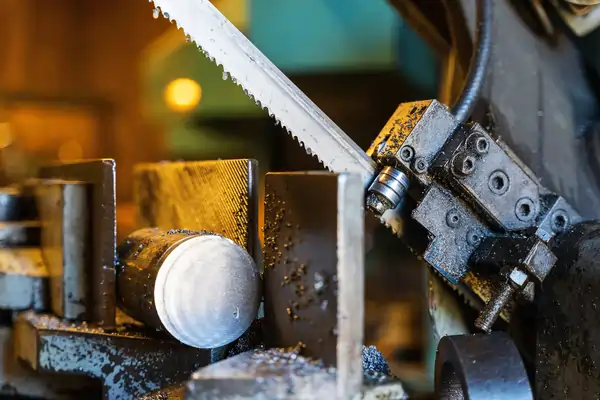
Why Stainless Steel Is Difficult to Cut
The biggest issue when cutting stainless steel is heat.
Stainless steel retains heat and can work harden quickly, which makes correct cutting conditions critical.
Unlike mild steel, stainless does not dissipate heat well. That heat stays at the cutting edge, which leads to:
- Rapid tooth wear
- Poor surface finish
- Stainless steel work hardening
- Properties of stainless steel
Work hardening is the real problem.
If the blade stops cutting and starts rubbing, the material hardens instantly — making the rest of the cut even harder.
That’s why stainless cutting is less about force, and more about control.
Unlike stainless, aluminium tends to load teeth rather than work harden.
👉 Guide: Cut Aluminium with a Bandsaw
Stainless steel work hardens quickly under poor cutting conditions — meaning the surface becomes harder with each pass.
👉 Learn more about work hardening and why it destroys blades
👉When stainless work hardens or the blade is pushed too hard, failure often appears at the weld
→ see why bandsaw blades break at the weld
Best Blade to Cut Stainless Steel on a Bandsaw
For most stainless-steel cutting, a bi-metal blade is essential.
- M42 bi-metal is the standard general-purpose choice
- It handles heat and wear far better than carbon blades
- Suitable for common grades including 304 and 316
For regular stainless cutting, greater blade life or more demanding applications,

Allperformer PM51 blades offer improved tooth-edge toughness, heat resistance and wear resistance.
- Highly suitable for stainless tube, pipe and profiles
- Also suitable for solid sections and other difficult-to-cut materials
- Particularly useful where standard M42 blades wear prematurely
- Available in practical industrial pitches including 27 × 0.9 mm 10/14 TPI for thin-wall stainless tube
Carbide blades can offer still higher productivity, but generally require larger sections, sufficient production volume and a suitably rigid machine to justify their cost.
For best results, use a high-quality bi-metal blade designed for stainless steel applications.
Choose the Correct TPI
Tooth pitch is critical when cutting stainless. –Calculator for the correct bandsaw blade TPI
You must keep multiple teeth engaged in the cut at all times.
- Minimum: 3 teeth in the cut
- Ideal: 6–12 teeth
As a general guide:
- Thin wall tube → 14–24 TPI
- Medium sections → 8–14 TPI
- Solid sections → 4–8 TPI
Too coarse and the teeth will strip.
Too fine and the blade will rub and overheat.
Choosing the correct tooth pitch is critical. If you’re unsure, see our full guide on choosing the correct TPI for metal cutting.
Thin wall stainless tube can be difficult to cut cleanly because maintaining enough teeth in the cut is not always mathematically possible.
Learn more about the minimum 3 teeth in the cut rule and correct TPI selection.
Set the Correct Speed and Feed
Incorrect speed and feed is where most problems start.
When you cut stainless steel on a bandsaw, heat control is everything.
Incorrect setup is one of the main causes of premature blade failure. See our guide on why bandsaw blades fail and how to prevent it.
Blade Speed
Run slower than mild steel.
Too fast = heat build-up → rapid dulling and work hardening.
Feed Pressure
You must apply enough pressure for the blade to cut, not rub.
- Too light → work hardening
- Too heavy → tooth damage
A steady, consistent feed is the goal.
If the blade is squealing, it’s usually rubbing — increase feed slightly.
Use Coolant or Lubrication
Stainless steel should not be cut dry if you want good results.
Coolant or lubrication:
- reduces heat
- improves blade life
- improves cut quality
Options range from full flood coolant to mist systems or even manual application.
Even a small amount of lubrication is far better than none.
Cutting Stainless Steel Tube and Pipe
Tube and pipe introduce an extra challenge — changing wall thickness through the cut.
To handle this:
- Use a finer TPI
- Clamp securely to prevent vibration
- Maintain steady feed pressure
Thin wall material is where tooth stripping and poor finish are most common if setup is wrong.
Common Problems and Causes
Slow cutting
- Wrong blade or worn blade
- Feed too light
- No lubrication
Blade going blunt quickly
- Excess heat
- Poor blade quality
- Running too fast
Work hardening
- Blade rubbing instead of cutting
Crooked cuts
- Blade deflection
- Too much pressure or incorrect setup
Final Thoughts
Cutting stainless steel successfully comes down to three things:
- the right blade
- correct tooth pitch
- proper speed and feed
Control those, and stainless becomes predictable and efficient to cut.
Ignore them, and it quickly becomes one of the most frustrating materials in the workshop.
If you regularly cut stainless steel on a bandsaw, getting these basics right will save time, improve cut quality, and significantly extend blade life.