

What Is Work Hardening in Metal Cutting?
Work hardening is one of the most common — and least understood — causes of poor cutting performance and short blade life.
It occurs when metal becomes harder during the cutting process, instead of being cleanly removed.
This is especially common when cutting:
- Stainless steel
- Mild steel (yes — even mild steel if cut poorly)
When work hardening occurs, each pass of the blade makes the material progressively harder to cut, leading to rapid tooth wear and eventual blade failure.
What Is Work Hardening?
Work hardening (also called strain hardening) occurs when metal is repeatedly deformed beyond its elastic limit.
https://en.wikipedia.org/wiki/Strain_hardening
Inside the metal:
- The structure contains tiny defects called dislocations
- Under stress, these move and begin to interfere with each other
As this builds up, the material becomes:
- Harder and stronger
- Less ductile (more brittle)
This is well understood in materials science (see: strain hardening explanation – Wikipedia or similar authority source).
That might sound beneficial — but in cutting, it’s the opposite.
👉 A harder surface becomes increasingly difficult for the blade to penetrate.
How Work Hardening Happens When Cutting Metal
Work hardening is usually caused by poor cutting conditions, not the material itself.
Instead of cutting cleanly, the blade begins to rub and deform the surface.
Common causes include:
- Too light feed pressure (blade skimming instead of cutting)
- Too high blade speed
- Dull or worn blade
- Incorrect TPI (too fine for the material — see our TPI selection guide)
When this happens:
- The blade heats and compresses the surface instead of removing material
- The surface layer becomes harder with each pass
👉 The next tooth then hits a harder layer than the one before
Why Work Hardening Destroys Bandsaw Blades
This is where things go bad quickly.
Once work hardening starts:
- The surface becomes harder than the parent material
- Each tooth must cut a progressively tougher layer
- Heat increases rapidly
This leads to:
- Rapid tooth wear
- Tooth stripping
- Loss of cutting accuracy
- Premature blade failure
In severe cases, a blade can be destroyed very quickly — even on relatively soft materials.
👉 This is a major cause of failures covered in our bandsaw blade failure guide.
Work Hardening of the Blade Itself (Why Blades Eventually Crack)
Work hardening doesn’t only affect the material being cut — it also affects the bandsaw blade itself over time.
A bandsaw blade is constantly flexing as it runs:
- Straight between the guides
- Curved as it passes around the wheels
Every rotation forces the steel to:
Bend → straighten → bend → straighten
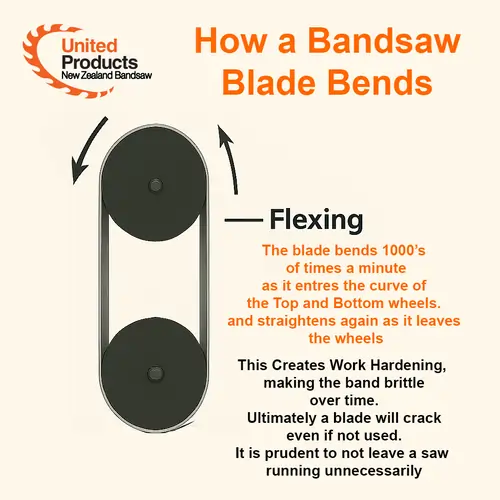
A bandsaw blade flexes thousands of times per minute as it passes around the wheels
— this repeated bending leads to work hardening and eventual fatigue cracking.
This creates cyclic plastic deformation in the blade material.
What Happens Inside the Blade
Like all steel, the blade contains microscopic defects called dislocations.
As the blade flexes repeatedly:
- The outer surface is stretched (tension)
- The inner surface is compressed
Over time:
- Dislocations accumulate and interfere with each other
- The steel becomes harder but less ductile
👉 The blade gradually loses its ability to flex safely
Why This Leads to Failure
As work hardening builds:
- The blade becomes strong but brittle
- It can no longer absorb stress through flexing
Cracks begin to form at high-stress points:
- Tooth gullets
- The back edge of the blade
- The weld
Using the right blade type helps reduce fatigue — a bimetal vs carbon bandsaw blade comparison shows bimetal blades handle heat and stress far better in demanding cuts.
Once a crack starts:
- It propagates rapidly
- The hardened steel cannot redistribute the load
👉 This results in sudden blade failure
Blade failure from work hardening often shows up at the weld — see why bandsaw blades break at the weld
Why Small Wheels and High Tension Make It Worse
Two factors dramatically accelerate this process:
Small Wheel Diameter
- Tighter bend radius
- Higher strain in the steel
- Faster work hardening
Over-Tensioning
- Increases baseline stress in the blade
- Increases stress during straightening
- Accelerates fatigue and crack growth
👉 This is why blades fail much faster on small machines or when over-tensioned
Important: This Happens Even Under Good Cutting Conditions
Even if cutting is perfect:
- The blade is still flexing thousands of times per minute
- Work hardening still occurs
👉 This is why bandsaw blades are a consumable product
👉 This is a major cause of failures covered in our bandsaw blade failure guide.
Materials Most Affected
Some materials are far more prone to work hardening than others:
Stainless Steel
- Most susceptible
- Work hardens very quickly
- Requires correct feed, speed, and blade selection
👉 See: cutting stainless steel with a bandsaw
Mild Steel
- Less prone, but still affected
- Common when using incorrect TPI or light feed
👉 See: cutting mild steel with a bandsaw
Alloy Steels
- Varies by composition
- Many behave similarly to stainless under poor cutting conditions
Aluminium
behaves differently again — it doesn’t work harden but instead loads the teeth.
👉 Link: bandsaw cutting aluminium
How to Prevent Work Hardening
Preventing work hardening comes down to cutting correctly — not gently.
1. Use the Correct TPI
Too many teeth = rubbing instead of cutting
👉 Choose a pitch that maintains proper tooth engagement
See: TPI selection guide
2. Apply Proper Feed Pressure
Let the blade bite and cut, not skim
- Too light = work hardening
- Too heavy = tooth damage
3. Run the Correct Blade Speed
Excessive speed increases heat and surface deformation
4. Use a Sharp Blade
A dull blade rubs — and rubbing causes work hardening fast
5. Break In the Blade Properly
Correct break-in improves cutting efficiency and reduces early damage
👉 (See: blade break-in guide)
Signs You Are Work Hardening the Material
If you see these, you’re already in trouble:
- Blue heat marks on the material
- Squealing or rubbing noise
- Slower cutting over time
- Blade dulling unusually quickly
👉 If ignored, this will quickly lead to blade failure.
In Simple Terms
- The blade should cut chips, not rub the surface
- Rubbing creates heat and deformation
- Deformation hardens the material
- Hardened material destroys the blade
👉 Cut properly, and work hardening doesn’t occur.