

The best bandsaw blade for wood depends on what you are cutting and how you are cutting it.
There is no single “best” blade — but there is a correct type for each job.
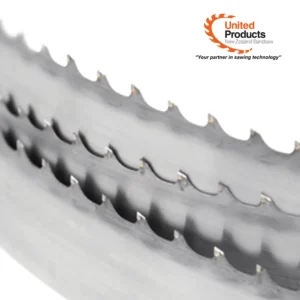

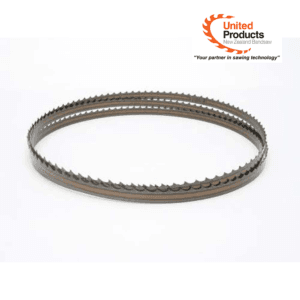
The Three Things That Matter
Choosing the right blade comes down to three factors:
- Blade width
- Tooth pitch (TPI)
- Type of cut (straight or curved)
Get these right, and most cutting problems disappear.
Portable Sawmill Blades Are Different
Cutting logs on a portable sawmill is a different application again.
Sawmill blades are used for long, continuous cuts through green timber, with much higher chip load and different wear conditions than standard wood cutting. Blade type, tooth durability, and overall blade life become far more important.
Most portable sawmills use long, narrow blades (typically around 34mm wide with a coarse tooth pitch), which are designed specifically for milling logs rather than general wood cutting. Portable sawmill and woodmill blades are a different application again.
If you are milling logs rather than cutting timber on a standard bandsaw, see our 👉 guide to Portable Sawmill Bandsaw blades
Blade Width – Straight vs Curved Cuts
Blade width controls how straight or tight the blade can cut.
- Wide blades
- Better for straight cuts
- More stable
- Ideal for ripping and resawing
- Narrow blades
- Designed for curves
- Can turn tighter radiuses
- Less stable in straight cuts
👉 If your blade is wandering, it is often too narrow.
👉 For straight cutting, use the widest blade your machine can handle. Wider blades are more stable and resist deflection.
How to Check the Maximum Blade Width
👉If your machine manual doesn’t specify the maximum blade width, you can check it manually.
- Disconnect power to the saw
- Fit your current blade
- Attach a small temporary marker (tape a small piece of card to the blade) to represent the wider blade width
- Slowly rotate the wheels by hand
👉 This allows you to check clearance through:
- guides
- guards
- wheel covers
If it fouls anywhere, the blade is too wide for that saw.
Tooth Pitch (TPI) – Smooth vs Fast Cutting
TPI (teeth per inch) controls how the blade cuts.
- Low TPI (coarse)
- Faster cutting
- Rougher finish
- Better for thick timber
- High TPI (fine)
- Slower cutting
- Smoother finish
- Better for thin material
👉 Low TPI (3–4) is typically used for thicker timber where fast cutting matters more than finish. ( but never less than 3 teeth in the cut)
👉 Higher TPI (6–10) is better for thinner material or where a smoother finish is needed. ( but never more than 21 teeth in the cut but preferably less than 14 )
👉 Using the wrong TPI is one of the most common causes of problems use our Wood TPI & Radius Calculator
Match the Blade to the Job
Straight cutting / ripping
- Use a wider blade
- Use a coarser TPI
Curved cutting
- Use a narrow blade
- Choose TPI based on thickness
👉 Don’t try to force a wide blade around tight curves — it will burn and wander.
General-purpose cutting
If you’re unsure:
- Choose a medium width blade
- Use a moderate TPI
👉 This will handle most basic work.
Common Problems Come From the Wrong Blade
Most issues are not machine faults — they are blade selection issues. But if your bandsaw still won’t cut straight even with the right blade
👉 See:
Why Your Bandsaw Still Won’t Cut Straight (Even After Setup)
- Blade wandering → often too narrow or dull
- Burning wood → often too fine TPI or slow feed
- Rough cuts → TPI not matched to material
👉 See:
- Why Bandsaw Blades Wander When Cutting Wood
- Why Wood Burns When Cutting with a Bandsaw
- Why Bandsaw Cuts Are Rough in Wood
In Simple Terms
Choose your blade based on:
- Width for control
- TPI for cutting performance
- Job type (straight or curved)
Match the blade to the job, and the saw will perform properly.
Cutting Logs on a Portable Sawmill Is Different
Portable sawmill and woodmill blades are a different application again.
When milling logs, blades are expected to make long continuous cuts through green timber, often with much higher chip load and more demanding conditions than normal wood cutting. Blade life, tooth durability, and blade type become much more important.
If you are cutting logs on a portable sawmill rather than using a standard bandsaw, see our guide to Portable Sawmill Bandsaw blades.
- 👉 bandsaw blades for cutting wood
- 👉 how to choose the correct TPI
- 👉 Wood TPI & Radius Calculator
- 👉 how to order a bandsaw blade