

Introduction
Small hobby bandsaws are extremely popular in home workshops, garages, schools, and small fabrication spaces.
Many people buy these machines expecting them to cut almost anything simply by fitting a different blade.
In reality, hobby bandsaws are designed primarily for cutting wood and similar materials. Their small wheels, thin blades,
and high blade speeds create limitations that many new users do not realise. These design features also explain why bandsaw blades can break more easily on small machines.
Understanding what a hobby bandsaw can realistically cut, how hobby blades differ from industrial blades, and why blades
sometimes fail will help you choose the correct blade and get much better results from your machine.
What Is a Hobby Bandsaw?
In the bandsaw trade, the term “hobby bandsaw” does not describe the person using it.
It refers to a specific class of small woodworking machines designed around thin blades and small wheels.
Typical characteristics include:
• Wheel diameter: roughly 195 mm – 230 mm (about 7.5″ – 9″)
• Blade thickness: approximately 0.36 mm (0.014″)
• Blade length: typically between about 1085 mm and 1830 mm
• High blade speed designed for cutting wood
These machines are built to be compact and affordable. To achieve this they use smaller motors, lighter frames,
and smaller wheels than industrial bandsaws. The design works very well for woodworking but also introduces
some important limitations.
Examples of Hobby Bandsaws Common in New Zealand
Several machines commonly sold in New Zealand fall into this category.
Examples include:
• Topmaq 195 mm bench bandsaw (WWBA1060)
• Topmaq 200 mm bench bandsaw (WWBA1080)
• Ozito 200 mm (8″) bandsaw
• ToolShed 250 mm wood cutting bandsaw
• Tooline hobby bandsaw sold through Mitre10
• Ryobi 250W 228mm Bandsaw sold through Bunnings


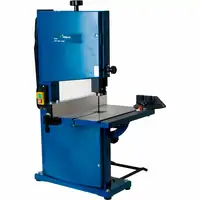
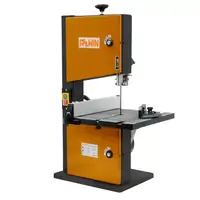
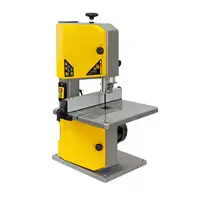
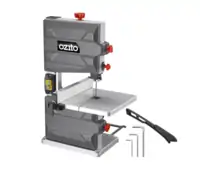
Although the exact specifications vary slightly between brands, these machines all follow the same design principles:
small wheels, thin blades, and high cutting speeds intended for woodworking.
If you’re looking for replacement hobby bandsaw blades, you can view our range of replacement hobby bandsaw blades.
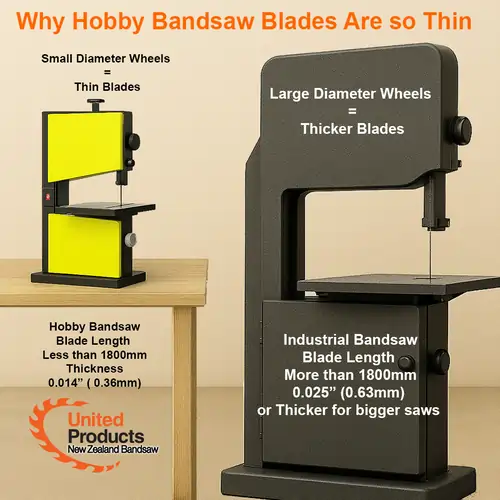
Why Hobby Bandsaw Blades Are So Thin
Hobby Bandsaw Blades used on these machines are typically around 0.014″ (0.36 mm) thick.
This thin blade is necessary because the wheels on hobby bandsaws are small. Every time the blade passes around a wheel it must bend, then straighten again as it leaves the wheel.
On a small machine this bending and straightening happens thousands of times per minute. Over time the repeated flexing creates metal fatigue, which is why blade thickness must be carefully matched to wheel diameter.
A commonly quoted rule of thumb is the “1/1000 rule”:
Wheel diameter ÷ 1000 ≈ maximum blade thickness.
For example:
200 mm wheel ÷ 1000 = 0.20 mm blade thickness
In theory this would suggest extremely thin blades for small hobby saws, often thinner than is practical for reliable cutting.
In practice however, blades also need enough beam strength to cut straight and must be thick enough to be reliably welded. Extremely thin blades would twist easily and be difficult to manufacture.
For this reason most hobby blades are produced at around 0.014″ (0.36 mm), which is a practical compromise between flexibility, durability, and cutting stability.
Small Wheels and Blade Fatigue
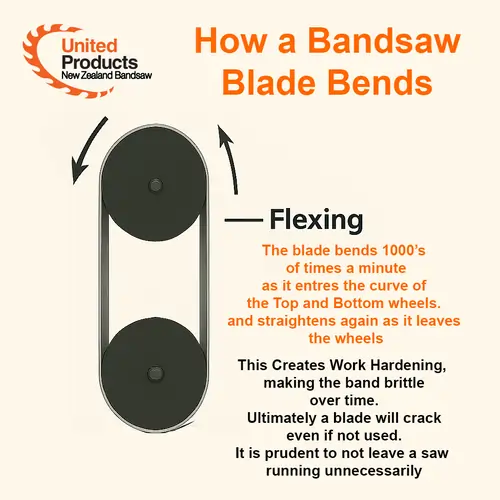
Wheel diameter plays a major role in bandsaw blade life.
A bandsaw blade is constantly being bent around the wheels and then straightened again as it leaves them.
On small hobby machines this cycle repeats thousands of times every minute, creating continuous fatigue stress in the steel.
This is why blade flexibility is critical for long life.
Industrial metal cutting bandsaws may use wheels 400 mm, 500 mm, or larger. These machines can safely run much thicker blades.
Hobby machines with wheels around 195–230 mm must use thinner blades so the steel can flex repeatedly without failing.
Blades designed for larger industrial machines are therefore not suitable for small hobby bandsaws.
Why Hobby Bandsaws Run Fast
Another key difference is blade speed.
Woodworking bandsaws typically run at very high speeds — often around 700 to 1000 metres per minute.
Metal cutting bandsaws operate much slower. Steel is often cut at speeds closer to 20–80 metres per minute.
This means a typical woodworking bandsaw may run 10–40 times faster than a metal cutting bandsaw.
Because of this, cutting steel on a hobby woodworking bandsaw rarely works well.
Why Bi‑Metal Blades Usually Do Not Work Well
Bi‑metal blades perform extremely well on proper metal cutting machines.
However, most bi‑metal blades are around 0.63 mm (0.025″) thick and designed for slower speeds and larger wheels.
When fitted to a hobby bandsaw several problems occur:
• The blade bends too tightly around the wheels
• The machine cannot tension the blade correctly
• The blade speed is far too fast for cutting steel
The result is often poor cutting performance, premature blade fatigue, and short blade life.
Another practical limitation is that most hobby bandsaw frames cannot generate enough blade tension for thicker industrial blades. Even if the blade does not break immediately, insufficient tension can result in wandering cuts and poor performance.
Why Carbon Blades Can Sometimes Be Better for Hobby Saws
For most hobby bandsaws, the technically correct blade is a thin hobby blade (around 0.014″ / 0.36 mm)
designed to run on the small wheels found on these machines.
However, there are situations where a carbon steel blade can be a more practical choice.
Carbon blades are generally more flexible than bi‑metal blades and tolerate the small wheel diameter better.
They can also cut non‑ferrous metals such as aluminium when used carefully.
Where carbon blades can make sense is when machines are used by inexperienced operators.
Thin hobby blades cut well but are relatively fragile. If the material twists, the operator forces the cut,
or the blade becomes kinked, the blade may break long before its normal service life.
A slightly thicker carbon blade may sometimes survive longer in these situations, even though it may eventually fail due
to work hardening. Repeated bending around small wheels can cause the steel to harden and become brittle,
eventually leading to cracking and breakage.
Even so, this failure may occur later than operator‑induced breakage of a very thin blade.
For this reason carbon blades are sometimes supplied to school workshops where machines are used by students
with varying levels of experience.
Blade Width and Curve Cutting
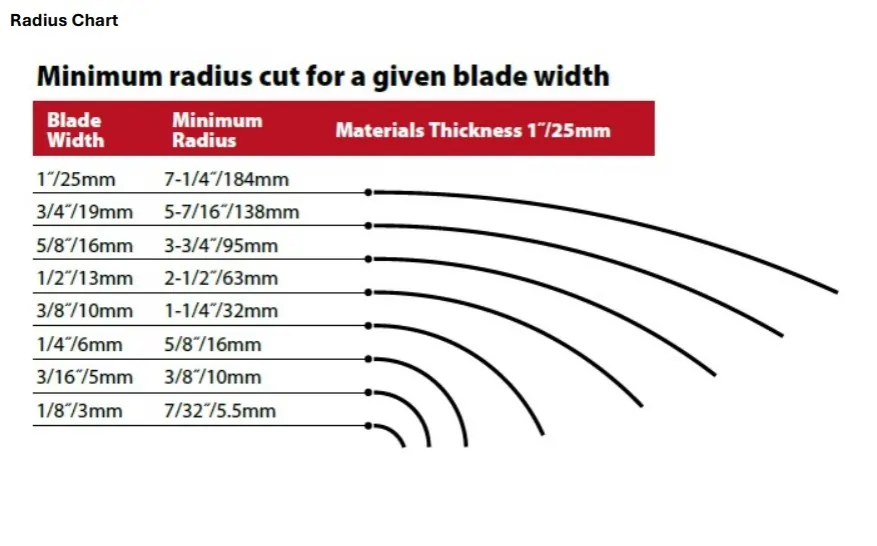
Blade width determines how tight a curve the saw can cut.
Wider blades provide greater stability and are best suited for straight cutting and resawing.
Narrow blades allow tighter curves and are better suited to detailed work.
Many hobby saw users achieve the best results by keeping more than one blade available.
Tooth Pitch (TPI)
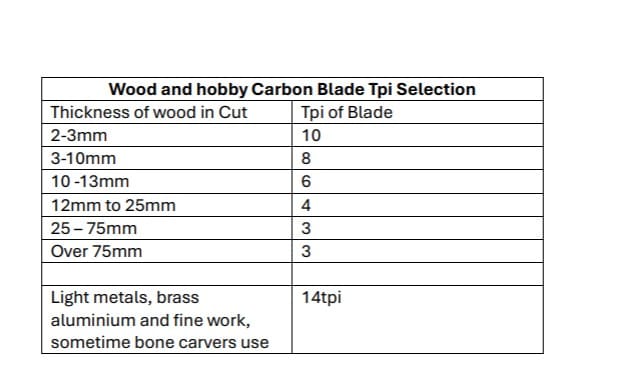
The number of teeth per inch (TPI) affects cutting performance.
Low TPI blades (coarser teeth) work best for thicker materials because they allow chips to clear from the cut.
Higher TPI blades are better suited to thin materials and produce smoother cuts.
A useful rule of thumb when selecting TPI is to ensure between 3 and 12 teeth are engaged in the material at any time.
Too few teeth in the cut can cause the blade to snag or strip teeth. Too many teeth can clog the gullets with chips, creating heat and shock loads that shorten blade life.
It is also important to remember that gullet capacity matters just as much as tooth count.
Many people focus only on the number of teeth, but the gullets between the teeth are what actually carry the sawdust or chips out of the cut. The gullets between the teeth must be large enough to clear sawdust or chips from the cut. If the gullets fill up, the blade cannot cut efficiently and excessive heat and stress can result.
Find the Correct Wood Bandsaw Blade TPI & Radius Calculator
Need help choosing a wood bandsaw blade?
Use our Wood Bandsaw Blade TPI & Radius Calculator to check tooth pitch and blade width before ordering.
Can You Cut Metal on a Hobby Bandsaw?
Many hobby users eventually try cutting metal on a woodworking bandsaw.
Technically this can work, but practically it is rarely ideal.
Hobby bandsaws run blades at very high speeds intended for wood cutting, while steel normally requires speeds
10–40 times slower.
Because of this, cutting steel on a hobby bandsaw often results in:
• Very short blade life
• Excessive heat
• Poor cutting performance
• Potential damage from metal swarf
Soft non‑ferrous metals such as aluminium or brass can sometimes be cut with a fine tooth blade and slow feed rate.
For a deeper explanation see our guide:
“Can You Cut Metal on a Wood Bandsaw?”
Why Bandsaw Blades Break on Hobby Bandsaws
Blade breakage is one of the most common problems hobby bandsaw users experience.
In most cases the blade itself is not faulty. Breakage usually occurs due to operating conditions.
Common causes include:
• Twisting the blade during a cut
• Using a blade too wide for tight curves
• Forcing the feed rate
• Pulling material backwards while the blade is running
• Blade tension set too low
• Striking nails, screws, or other hidden objects
• Blade guides set too tight creating friction and heat
Because hobby blades are very thin, they are less tolerant of operator mistakes than the thicker blades used on
larger industrial machines.
Summary
Hobby bandsaws are excellent machines when used within their design limits.
They are designed primarily for woodworking and rely on thin blades that can flex around small wheels.
Their high blade speeds make them efficient for cutting wood but unsuitable for heavy metal cutting.
Understanding these limits and choosing the correct blade type, width, and tooth pitch will dramatically improve cutting performance and blade life.
👉 Measure your Bandsaw Blade Length
👉 Order a Hobby Bandsaw Blade online