

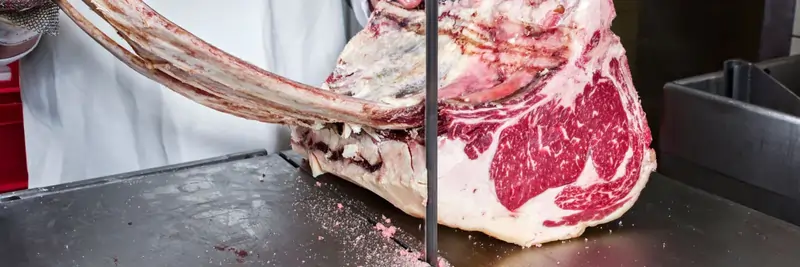
3 TPI meat bandsaw blades are commonly used in New Zealand butcher shops and supermarkets for frozen and bone-in cutting applications.
Not all meat bandsaw blades are designed for the same application.
Fresh meat, frozen product, bone-in cutting, fish processing, and poultry all place different demands on a bandsaw blade. Choosing the correct tooth pitch and blade style helps improve:
- cut quality
- blade life
- waste reduction
- machine performance
At United Products, we custom-weld meat and fish bandsaw blades in New Zealand for butcher shops, supermarkets, processors, fish handling, commercial kitchens, and home users. One of the most common questions we receive is whether to use a 3 TPI or 4 TPI meat bandsaw blade.
In reality, the answer depends heavily on what you are cutting.
Why Frozen Meat Is Harder on Bandsaw Blades
Frozen meat and bone-in product place significantly higher stress on a bandsaw blade than fresh meat.
Compared with fresh product, frozen meat:
- is harder and more abrasive
- increases tooth loading
- creates more vibration
- increases impact stress on the tooth edge
- places more fatigue stress on the blade body
Frozen bone-in cutting is especially demanding because the blade repeatedly impacts hard material while clearing waste from the cut.
Most meat cutting bandsaw blades use hook-style tooth geometry designed to pull product efficiently through the cut. This aggressive tooth shape improves cutting performance on frozen meat, carcass work, and bone-in applications while helping maintain cutting speed in demanding conditions.
This is why frozen meat applications generally favour coarser tooth pitches and more durable cutting setups.
Why 3 TPI Is the Most Common Meat Blade in New Zealand
In New Zealand, most butcher shops and supermarkets use 3 TPI meat bandsaw blades for general meat cutting.
This is largely because many operators regularly cut:
- chilled meat
- partially frozen product
- bone-in product
- heavy carcass sections
A 3 TPI blade has larger gullets between the teeth, allowing it to clear waste and bone dust more effectively during heavier cutting.
Benefits of 3 TPI blades include:
- better waste clearance
- improved performance on frozen product
- lower tooth loading
- reduced vibration in heavy cuts
- better performance on bone-in meat
- longer life in demanding applications
This is why 3 TPI blades are commonly preferred by:
- supermarkets
- commercial butchers
- processors
- high-volume meat operations
At United Products, approximately 90% of our meat blade sales are 3 TPI blades.
When 4 TPI Meat Bandsaw Blades Work Well
4 TPI blades are commonly used for:
- fresh meat
- poultry
- lighter-duty cutting
- smoother finish requirements
- smaller home or hobby meat saws
The finer tooth pitch can produce a slightly smoother cut finish in softer fresh product.
A 4 TPI blade can still cut bone-in meat successfully, but many operators find it produces more fine bone dust and does not clear waste as aggressively as a 3 TPI blade in heavier applications.
In New Zealand, 4 TPI blades are more commonly used by:
- home users
- lighter-duty butcher shops
- poultry users
- customers mainly cutting fresh product
Interestingly, Australian operators appear to use 4 TPI blades more commonly across a wider range of applications than is typical in New Zealand.
4 TPI Blades for Home Meat Saws
For smaller home-use meat saws where the operator is mainly dicing fresh meat into smaller portions for curries, stews, or general kitchen use, a 4 TPI blade is often the most versatile option. It provides smoother cutting in fresh product while still handling occasional bone-in cuts reasonably well.
Fresh Meat vs Frozen Product Performance
Fresh Meat
Fresh meat generally benefits from:
- smoother cutting action
- finer tooth pitch
- cleaner finish
- reduced tearing
For fresh product, many operators prefer:
- 4 TPI blades
- thinner blades for smaller machines
- finer cutting feel
Frozen Meat & Bone-In Product
Frozen and bone-in applications generally favour:
- coarser tooth pitches
- stronger feed performance
- improved waste clearance
- reduced tooth loading
- better vibration control
For these applications, 3 TPI blades are usually preferred.
Fish Processing and Fine Cutting Applications
Fish and delicate trimming applications often require:
- finer tooth pitches
- thinner blades
- reduced product waste
- smoother finish quality
In high-value fish processing, reducing waste is especially important in high-value meat and fish processing where improved yield directly affects profitability.
Thin fish-processing blades help minimise product loss while improving finish quality on delicate flesh.
Blade Thickness Still Matters
Tooth pitch is important, but blade thickness also affects performance.
Small benchtop meat saws often require thinner blades because thicker blades fatigue faster around small wheel diameters.
Many compact saws use thinner .020″ blades to:
- improve flexibility
- reduce fatigue cracking
- improve performance on smaller wheels
Heavier-duty commercial saws may use thicker blades for improved stability in demanding frozen or bone-in cutting.
Machine Setup Becomes More Important on Frozen Product
Frozen product places much higher stress on both the blade and the machine.
Problems with:
- blade tension
- tracking
- wheel alignment
- worn guides
- damaged cleaners
- vibration
often become far more obvious when cutting frozen meat.
If blades repeatedly crack, wander, or wear prematurely, the issue may be the bandsaw machine setup rather than the blade itself.
Choosing the Right Meat Bandsaw Blade
The best blade depends on:
- fresh vs frozen product
- bone-in cutting
- machine size
- wheel diameter
- cutting volume
- desired finish quality
General Guide
| Application | Common TPI | Typical Use |
|---|---|---|
| Frozen meat & bone-in product | 3 TPI | Supermarkets, processors, commercial butchers |
| Fresh meat & poultry | 4 TPI | Fresh meat cutting, lighter-duty use |
| Fish & delicate trimming | 6 TPI | Fish processing, gourmet cuts |
Need Help Choosing the Correct Meat Bandsaw Blade?
United Products supplies custom-welded meat and fish bandsaw blades throughout New Zealand for:
- butcher shops
- supermarkets
- processors
- fish handling
- commercial kitchens
- home users
If you are unsure what blade your machine requires, contact us with:
- blade length
- machine model
- application type
and we can help recommend the correct blade for your saw. See our Commercial Meat Bandsaw Blade Size Guide for common machine sizes used throughout NZ.