

What “Structurals” Really Means in the Bandsaw World
In metal-cutting bandsawing, the term structurals is often misunderstood, and therefore so are Structural Steel Cutting Bandsaw Blades.
Many people assume “structural steel cutting” only refers to large construction beams used in building work. In reality, within the bandsaw industry, structurals usually refers to materials that create interrupted, irregular, or vibration-prone cutting conditions for the blade.
This includes many of the most common materials found in engineering and fabrication workshops, including:
- RHS (Rectangular Hollow Section)
- SHS (Square Hollow Section)
- Pipe and tube
- Angle iron
- Channel
- Aluminium extrusion
- Purlins and profile steel
- I-beams and H-beams
- Bundle-cut material
These materials are often referred to as profiles within the bandsaw industry because the blade is repeatedly entering and exiting changing cross-sections during the cut.
That interrupted tooth engagement creates very different cutting conditions compared with cutting solid steel bar.
What Materials Are Considered Structural or Profile Cutting?
In bandsaw terminology, structural or profile cutting generally refers to materials where tooth engagement constantly changes during the cut.
| Material Type | Considered Structural/Profile Cutting? |
|---|---|
| RHS / Box Section | Yes |
| SHS | Yes |
| Pipe & Tube | Yes |
| Angle Iron | Yes |
| Channel | Yes |
| Aluminium Extrusion | Often |
| I-Beams / H-Beams | Yes |
| Purlins & Profiles | Yes |
| Bundle Cutting | Yes |
| Solid Round Bar | Usually No |
This is why many fabrication shops, steel merchants, engineering workshops, and profile-cutting environments use blades specifically designed for structural cutting applications.
Metal cutting Bandsaw Blades
Why Structural Materials Are Hard on Bandsaw Blades
Structural materials create what blade manufacturers refer to as interrupted cuts.
Instead of the teeth remaining continuously engaged in solid material, the blade repeatedly:
- enters the material,
- exits hollow sections or gaps,
- and re-engages again.
Every re-entry into the material places impact stress on the tooth edge.
This repeated shock loading can quickly damage blades not designed for interrupted cutting conditions.
Common problems when cutting structurals include:
- stripped teeth,
- snagging or grabbing,
- excessive vibration,
- noisy cutting,
- poor surface finish,
- blades wandering in the cut,
- and premature dulling or blade failure.
These problems become even worse when:
- feed pressure is too aggressive,
- tooth pitch is too coarse,
- or the wrong blade style is used.
Why Hollow Sections Can Be Harder Than Solid Steel
One of the most misunderstood parts of structural cutting is that hollow sections are often harder on blades than solid steel.
Many users assume thin-wall RHS or tube should cut easily because there is less material. In reality, hollow sections can create very unstable cutting conditions.
As the blade enters and exits the wall of the material:
- tooth loading changes rapidly,
- vibration increases,
- the blade can snag or jump,
- and teeth may lose proper support.
This is why thin-wall tube and hollow sections frequently strip teeth when cut using coarse or unsuitable blades.
Choosing the correct bandsaw blade TPI
Structural steel, RHS, and thin wall tube often require finer variable pitch blades to maintain enough teeth in the cut and reduce tooth stripping. Learn more about the minimum 3 teeth in the cut rule and correct TPI selection.
The larger the hollow section compared with its wall thickness, the more important correct blade selection becomes.
Why Angle Iron Can Be Difficult to Cut
Angle iron is another common structural/profile cutting application that can create interrupted tooth engagement.
As the blade enters and exits each leg of the angle:
- tooth loading changes rapidly,
- vibration can increase,
- and coarse tooth pitches may snag or strip teeth.
Thin-wall angle iron is often best cut using a variable pitch profile blade designed for interrupted cuts.
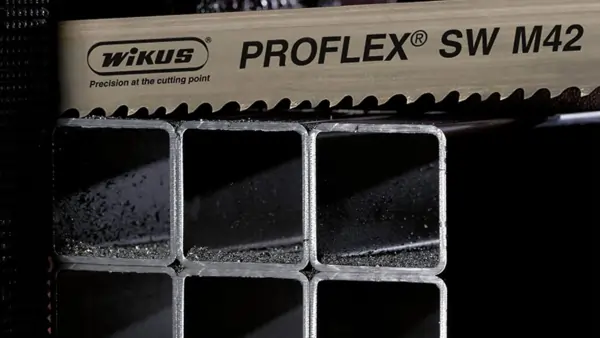
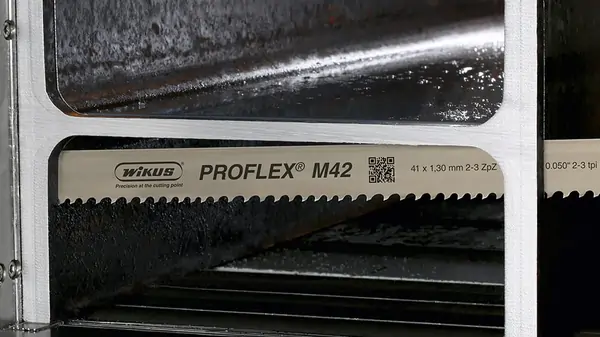
For many fabrication workshops, blades such as the Wikus Proflex M42 provide smoother cutting performance and reduced vibration compared with standard general-purpose blades.
Typical TPI ranges:
- Thin angle iron: 8/12 or 10/14
- Medium wall angle: 6/10
- Heavy structural angle: 4/6
Why Bundle Cutting Behaves Like Structural Cutting
Even solid material can behave like a structural cutting application when bundle cut.
When cutting bundles:
- teeth repeatedly pass through gaps,
- vibration increases,
- tooth loading becomes inconsistent,
- and shock forces on the tooth edge rise sharply.
This creates interrupted cutting conditions similar to cutting:
- RHS,
- tube,
- angle iron,
- or profile steel.
For this reason, bundle cutting often benefits from the same blade styles used for structural and profile cutting applications.
This is especially true when cutting:
- multiple tubes,
- stacked angle,
- bundled flats,
- or loosely clamped material.
What Makes Structural Bandsaw Blades Different?
Structural/profile cutting blades are specifically designed to handle interrupted cuts more smoothly and reduce tooth damage.
Compared with standard general-purpose blades, structural blades often feature:
- specialised profile tooth geometry,
- variable tooth pitch,
- reinforced tooth support,
- vibration-reducing tooth forms,
- and improved resistance to tooth stripping.
These features help stabilise the blade during interrupted cuts and reduce shock loading on the teeth.
The result is often:
- smoother cutting,
- reduced vibration,
- lower noise,
- improved blade life,
- less tooth breakage,
- and more reliable cutting performance.
Wikus Proflex M42 – Designed for Profiles and Interrupted Cuts
The Wikus Proflex M42 was specifically developed for cutting profiles, beams, tube, and interrupted-cut applications.
Unlike standard general-purpose blades, Proflex uses a specialised profile tooth geometry with reinforced tooth support designed to reduce:
- tooth breakage,
- vibration,
- instability,
- and noise during profile cutting.
Wikus describes the blade as:
“The perfect band saw blade for profiles.”
The blade is specifically optimised for:
- metal profiles and beams,
- interrupted cutting conditions,
- and applications where vibration and tooth shock are common.
The variable pitch design also helps reduce vibration and noise while improving cutting smoothness.
Proflex M42 is particularly well suited to:
- RHS and SHS,
- pipe and tube,
- angle iron,
- aluminium extrusion,
- profile steel,
- fabrication work,
- and general engineering environments where interrupted cuts are common.
For many workshops, it provides an excellent balance between durability, smooth cutting performance, and versatility.
Structural Bandsaw blades
Download the Wikus Proflex M42 technical data sheet for full specifications and application information.
As the New Zealand supplier for Wikus bandsaw blades, we regularly help fabrication and engineering workshops select blades for difficult profile and interrupted-cut applications.
Hakansson Powermax for Heavy Structural Applications
For heavier structural cutting applications, Hakansson Powermax blades are designed specifically for interrupted cutting conditions in:
- tubes,
- profiles,
- beams,
- and bundle cutting applications.
The specialised setting pattern is designed to:
- reduce vibration,
- lower noise,
- improve shock resistance,
- and reduce tooth breakage during difficult structural cutting.
Powermax blades are particularly useful in heavier fabrication environments where:
- bundle cutting is common,
- larger structural sections are cut regularly,
- or interrupted tooth loading is severe.
Choosing the Correct TPI for Structural Steel Cutting
Tooth pitch selection is especially important when cutting hollow sections and structurals.
A blade that is too coarse may:
- snag aggressively,
- strip teeth,
- or jump as it enters and exits the material.
A blade that is too fine may:
- cut slowly,
- generate excess heat,
- or load up with chips.
As a general rule, structural/profile cutting usually requires a finer pitch than many operators expect.
mild steel cutting guide
Calculate the recommended TPI here.
| Material | Typical TPI Range |
|---|---|
| Thin-wall RHS / SHS | 10/14 |
| Pipe & Tube | 8/12 or 10/14 |
| Angle Iron | 8/12 |
| Medium Structural Sections | 6/10 |
| Heavy Beams | 4/6 |
| Large Thick-Wall Structures | 3/4 or 2/3 |
The goal is generally to maintain at least 3 teeth engaged in the material throughout the cut.
When cutting profiles, wall thickness is often more important than the outside size of the material.
For example:
- a large thin-wall tube may still require a fine pitch blade,
- while a smaller solid section may suit a much coarser pitch.
For more detailed information, see our guide:
How to Choose the Correct Bandsaw Blade TPI
Common Problems When Cutting Structurals
Stripped Teeth
Usually caused by:
- interrupted tooth shock,
- too coarse a tooth pitch,
- excessive feed pressure,
- or unsuitable blade geometry.
Thin-wall tube and hollow sections are especially prone to stripping teeth when using coarse blades.
Blade Snagging or Jumping
Often caused by:
- aggressive tooth engagement,
- coarse pitch selection,
- or unstable cutting conditions in hollow sections.
Structural/profile blades are designed to reduce these problems.
Excessive Vibration
Vibration is extremely common in:
- pipe,
- tube,
- angle,
- extrusion,
- and bundle cutting applications.
Variable pitch profile blades help reduce harmonic vibration during interrupted cuts.
Poor Surface Finish
Poor finish is commonly caused by:
- vibration,
- inconsistent tooth engagement,
- incorrect tooth pitch,
- or unstable blade tracking during profile cutting.
Premature Blade Failure
General-purpose blades can struggle in repeated structural cutting applications because the teeth are subjected to continuous impact loading.
Using a blade designed specifically for profiles and interrupted cuts can significantly improve blade life.
Structural Steel Cutting Requires a Different Blade Approach
Structural cutting applications place very different demands on a bandsaw blade compared with cutting solid steel.
Understanding what structurals really means in the bandsaw industry helps explain why specialised profile-cutting blades exist — and why they often perform significantly better in hollow sections, tube, profiles, and bundle-cutting applications.
Choosing the correct blade type can dramatically improve:
- blade life,
- cutting stability,
- surface finish,
- vibration control,
- and overall cutting performance.
For many fabrication and engineering workshops, moving from a general-purpose blade to a true structural/profile blade can make a substantial difference in both blade life and cutting reliability.
When a Premium Bi-metal Blade May Still Be Suitable
Not every difficult material immediately requires a carbide blade.
For many engineering workshops, premium bi-metal blades such as PM51 can successfully cut materials that are beyond the capabilities of standard M42 blades while still offering lower operating costs than carbide.
PM51 blades are often a good option for:
- Tough alloy steels
- Higher strength engineering materials
- Some stainless applications
- Production cutting where carbide is unnecessary
M51 vs PM51 – What’s Changed and Why It Matters
FAQ: About Structurals and structural specific blades
Need Help Choosing a Structural Cutting Blade?
If you regularly cut RHS, SHS, pipe, tube, angle iron, beams, or bundle-cut material, choosing the correct blade style can dramatically improve blade life and cutting performance.
Our structural/profile cutting blade range includes:
- Wikus Proflex M42
- Hakansson Powermax
- Variable pitch M42 blades for interrupted cuts
Browse our: