

Choosing the correct TPI (teeth per inch) is one of the most important parts of bandsaw blade selection, especially when cutting metal.
Using a blade with too few teeth engaged in the material can cause:
- tooth stripping
- vibration and chatter
- snagging or grabbing
- rough cutting
- reduced blade life
- poor cutting performance
This is why most bandsaw blade guides refer to the “3 teeth in the cut” rule.
While it is a very useful guideline, real-world cutting is often more complicated than a simple mathematical rule. Material thickness, blade width, machine size, and chip clearance all affect what blade pitch will work best.
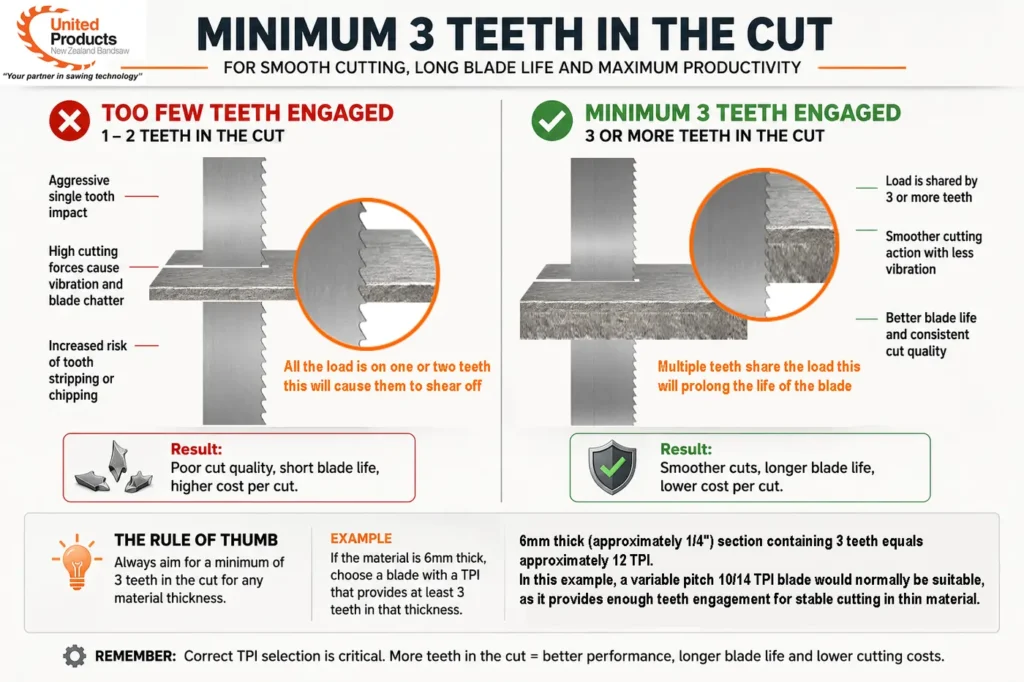
Correct bandsaw blade TPI selection helps maintain enough teeth in the cut to reduce tooth stripping, vibration, and poor cutting performance.
What Does “3 Teeth in the Cut” Mean?
The rule simply means there should ideally be at least 3 teeth engaged in the material being cut at all times.
When several teeth share the cutting load:
- the cut becomes smoother
- vibration is reduced
- tooth impact loading decreases
- blade life generally improves
If only one or two teeth contact the material, each tooth takes a much heavier impact as it enters the cut. This can damage the tooth tips or strip teeth from the blade.
This is particularly important when cutting:
- thin wall tube
- RHS and structural sections
- stainless tube
- bundle material
- interrupted cuts
Why Too Few Teeth Causes Problems
Bandsaw blades are designed so the cutting load is spread across multiple teeth.
When a blade is too coarse for the material thickness, the teeth strike the material too aggressively. Instead of producing a smooth controlled cut, the blade can:
- snag
- vibrate
- chatter
- strip teeth
- cut roughly
Thin wall tube is one of the most common causes of tooth stripping because the blade repeatedly enters and exits the material. This creates impact loading on the tooth tips.
The problem becomes worse when:
- feed pressure is excessive
- the material is not clamped securely
- large industrial blades are used on very thin sections
- the blade pitch is too coarse
Example — Calculating Minimum Teeth in the Cut
If your material is 6mm thick (approximately 1/4″), you should select a blade that provides at least 3 teeth within that thickness.
A 1/4″ section containing 3 teeth equals approximately 12 TPI.
In this example, a variable pitch 10/14 TPI blade would normally be suitable, as it provides enough tooth engagement for stable cutting in thinner material.
Calculator for the correct bandsaw blade TPI
Practical Limits of the 3 Teeth in the Cut Rule
The “3 teeth in the cut” rule is a useful guideline, but it is not always possible to achieve exactly in real-world cutting.
This is especially true with very thin-wall tube, exhaust tube, stainless handrail tube, and similar hollow sections.
For example, 1.6mm wall thickness is approximately 1/16″. To have 3 teeth engaged in that thickness, the blade would theoretically need to be around 48 TPI.
That calculation is correct:
3 teeth in 1/16″ = 48 TPI
In practice, bandsaw blades are not usually available in pitches that fine, especially in wider industrial blade widths.
Even a 24 TPI wavy-set blade, which is designed for thin-wall cutting in smaller 13mm blade widths, only gives around 1.5 teeth in a 1.6mm wall.
That means thin-wall tube cutting is often a compromise. The aim is to use the finest practical blade available for the machine and blade width, while still keeping enough blade strength and gullet capacity for the job.
Common practical choices include:
| Blade width / type | Common fine pitch options |
|---|---|
| 13mm blades | 14/18 TPI or 24 TPI wavy-set where available |
| 27mm blades | often up to around 18 TPI |
| Wider industrial blades | generally available in progressively coarser pitches |
For many thin-wall applications, customers commonly use 14/18 TPI or 10/14 TPI, depending on the machine, blade width, material, and how the tube is being held.
The key point is that the 3 teeth rule should not be treated as a perfect mathematical rule in every situation. It is a guide to help avoid using a blade that is far too coarse for the material.
With very thin material, choose the finest suitable blade available, clamp the material securely, and avoid excessive feed pressure.
Do Not Go Too Fine for Thick Material
While too few teeth in the cut can strip teeth, going too fine can also cause problems.
Fine pitch blades have smaller gullets between the teeth. When cutting thicker material, those small gullets may not have enough space to carry chips out of the cut.
This can cause:
- chip packing
- excess heat
- slow cutting
- premature tooth wear
- reduced blade life
This is why blade selection is always a balance between tooth engagement and chip clearance.
A fine pitch blade may be necessary for thin-wall tube, but it is usually the wrong choice for heavy solid steel. For thicker sections, a coarser pitch is needed so the gullets can clear the chips properly.
How Many Teeth in the Cut Is Too Many?
Some guides suggest very high numbers of teeth in the cut, but in practical metal cutting, more is not always better.
Once there are too many teeth engaged, each tooth takes a very small chip and the gullets may not clear material efficiently. The blade can start rubbing instead of cutting cleanly.
As a practical workshop guide, around 12–14 teeth engaged is often a useful upper range for many applications. Beyond that, the cut may become slower and less efficient, especially in thicker material.
The goal is not simply to use the finest blade possible. The goal is to choose a blade that has:
- enough teeth engaged to avoid snagging or stripping
- enough gullet space to clear chips
- enough strength for the blade width and machine
- the correct pitch for the material thickness and section type
Typical Practical TPI Examples
| Material Type | Typical Blade Pitch |
|---|---|
| Thin wall stainless tube | 14/18 TPI |
| Exhaust tube | 14/18 TPI or finer |
| General RHS and structurals | 10/14 TPI or 6/10 TPI |
| Medium solid steel | 6/10 TPI |
| Heavy solid steel | 4/6 TPI or 2/3 TPI |
| Large structurals and bundles | Variable pitch preferred |
These are general guides only. The best blade depends on:
- material thickness
- section shape
- machine size
- blade width
- production volume
- feed control and clamping
Variable Pitch vs Straight Pitch
Variable pitch blades are commonly preferred for metal cutting because they help reduce vibration and harmonics.
Instead of every tooth striking the material at identical spacing, the varying tooth pitch breaks up vibration patterns and generally produces smoother cutting.
Variable pitch blades are especially useful for:
- structural steel
- RHS and tube
- mixed section cutting
- interrupted cuts
- general workshop cutting
Straight pitch blades are still used successfully in some applications, particularly where a consistent material size is being cut repeatedly.
How to Count TPI on a Bandsaw Blade
On a straight pitch bandsaw blade, TPI is usually counted by measuring one inch along the blade and counting the number of teeth in that distance. Start from a gullet and count how many complete teeth fall within one inch.
Variable pitch blades are harder to count because the tooth spacing changes along the blade. Counting only one inch may give a misleading result depending on where you start.
A better method is to measure a longer section of blade, such as 254mm. This equals 10 inches.
Mark the start and finish points, then count every tooth in that 254mm section. Mark each tooth with a Sharpie as you count so you do not lose your place.
Then divide the total number of teeth by 10 to get the average TPI.
Examples:
| Variable Pitch Blade | Average TPI |
|---|---|
| 4/6 TPI | 5 TPI average |
| 6/10 TPI | 8 TPI average |
| 8/12 TPI | 10 TPI average |
| 10/14 TPI | 12 TPI average |
This is why a 10/14 TPI blade is often treated as roughly equivalent to a 12 TPI average, while still giving the vibration-reducing benefits of variable pitch tooth spacing.
Thin Wall Tube Is One of the Hardest Applications
Very thin-wall material is often one of the most difficult applications for bandsaw blades.
The blade repeatedly:
- enters the material
- exits the material
- re-enters the opposite wall
This interrupted cutting action creates high tooth impact loading.
Machine rigidity, vice clamping, blade tension, feed pressure, and blade pitch all become critical.
This is why thin-wall stainless handrail tube, exhaust tube, and light structural sections often strip teeth quickly when cut with blades that are too coarse.
Common TPI Selection Mistakes
Some of the most common blade selection mistakes include:
- choosing blade pitch based on the overall tube size instead of wall thickness
- using coarse blades on thin wall tube
- using excessively fine blades on heavy solids
- applying excessive feed pressure
- poor material clamping
- using worn blades too long
- ignoring break-in procedures on new blades
Correct TPI selection is one of the easiest ways to improve:
- blade life
- cut quality
- cutting speed
- overall cost per cut
Conclusion
The “3 teeth in the cut” rule remains one of the most useful guidelines for selecting a metal cutting bandsaw blade.
It helps prevent:
- tooth stripping
- vibration
- snagging
- poor blade life
However, real-world cutting is always a compromise between:
- tooth engagement
- gullet capacity
- blade strength
- machine capability
- material type
Very thin materials may never fully satisfy the theoretical 3 teeth rule, while thick solid materials require enough gullet space to clear chips effectively.
Choosing the correct TPI for the application is one of the biggest factors in achieving reliable cutting performance and good blade life.
If you are unsure which blade pitch is best for your material, contact United Products for advice on selecting the correct bandsaw blade for your application.